
Psychedelics, research, therapy and the witch hunt.
Dear colleagues, please stay calm. Stop the “witch hunt” and don’t send your patients straight to psychiatry. First, study the information, talk to the patients. Don’t let fear guide you. Help people integrate their unique experiences and refer them to specialists who understand this work and can provide the necessary support.
In Germany, ketamine, MDMA, and other therapeutic methods have been in use for quite some time. Please don’t treat patients or therapists like witches to be burned at the stake for such ideas (e.g., healing trauma and depression through psychedelic experiences). Perhaps these individuals have already tried every available therapy, taken every possible antidepressant, and this is their last hope.
Thank you for your attention.
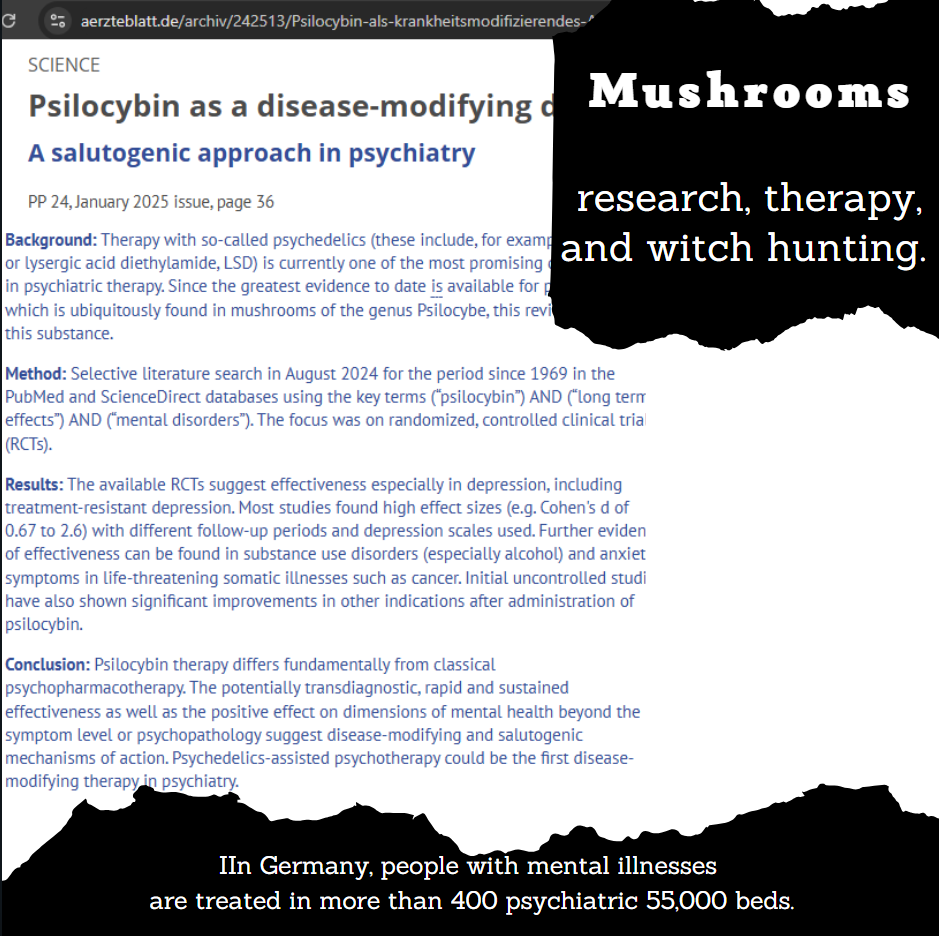
https://www.aerzteblatt.de/archiv/242513/Psilocybin-als-krankheitsmodifizierendes-Arzneimittel
“In Germany, people with mental illness are treated in more than 400 psychiatric and 250 psychosomatic clinics with 55,000 and 11,000 beds respectively. The annual number of cases is almost one million and has more than doubled since 1990. In no other medical discipline is hospital bed utilization so high (about 95%)
After unsuccessfully treating depression, only about a quarter of patients achieve complete remission after switching to another antidepressant!”
Full research article, machine translation:
SCIENCE
Psilocybin as a disease-modifying drug
A salutogenic approach in psychiatry
PP 24, January 2025 issue, page 36
Spangemacher, Moritz ; Mertens, Lea J. ; Färber, Luca V. ; Jungaberle, Andrea ; Jungaberle, Henrik ; Gründer, Gerhard
Subscribe to NewsletterSubscribe to NewsletterTo the homepageTo the homepage
Background: Therapy with so-called psychedelics (these include, for example, psilocybin or lysergic acid diethylamide, LSD) is currently one of the most promising developments in psychiatric therapy. Since the greatest evidence to date is available for psilocybin, which is ubiquitously found in mushrooms of the genus Psilocybe, this review focuses on this substance.
Method: Selective literature search in August 2024 for the period since 1969 in the PubMed and ScienceDirect databases using the key terms (“psilocybin”) AND (“long term effects”) AND (“mental disorders”). The focus was on randomized, controlled clinical trials (RCTs).
Results: The available RCTs suggest effectiveness especially in depression, including treatment-resistant depression. Most studies found high effect sizes (e.g. Cohen’s d of 0.67 to 2.6) with different follow-up periods and depression scales used. Further evidence of effectiveness can be found in substance use disorders (especially alcohol) and anxiety symptoms in life-threatening somatic illnesses such as cancer. Initial uncontrolled studies have also shown significant improvements in other indications after administration of psilocybin.
Conclusion: Psilocybin therapy differs fundamentally from classical psychopharmacotherapy. The potentially transdiagnostic, rapid and sustained effectiveness as well as the positive effect on dimensions of mental health beyond the symptom level or psychopathology suggest disease-modifying and salutogenic mechanisms of action. Psychedelics-assisted psychotherapy could be the first disease-modifying therapy in psychiatry.
In Germany, people with mental illnesses are treated in more than 400 psychiatric and 250 psychosomatic clinics with approximately 55,000 and 11,000 beds respectively. The annual number of cases is almost one million, and has more than doubled since 1990. In no other medical discipline is the occupancy rate of hospital beds anywhere near as high (around 95%) ( 1 ). In addition, there is a dense network of outpatient treatment options that still do not meet demand. The number of prescriptions for antidepressants has more than doubled since 1990, and not only in Germany; approximately 5 million Germans are taking an antidepressant at any given time, and a plateau has not been reached ( 2 ). The prevalence of depression and other mental illnesses remains high ( 3 ), and in the last 15 years in particular it appears to have increased significantly ( 4 ).
At the same time, the effectiveness of available antidepressants is moderate at best ( 5 ). Under naturalistic conditions, less than 50% of patients treated with a selective serotonin reuptake inhibitor (SSRI) respond to treatment, and only 30% achieve remission ( 6 ). However, even if such remission is reflected on the usual rating scales, for many patients this does not reflect a state of mental health in which the individual can develop his or her skills, cope with the stress of everyday life, work productively, and contribute to his or her community ( 7 ). After unsuccessful treatment for depression, only about a quarter of patients achieve complete remission after switching to another antidepressant ( 8 ). Even after four different consecutive treatments, only two-thirds of patients achieve remission, and relapse rates are high ( 8 ). In addition, many patients with mental illnesses receive long-term treatment, even though this does not adequately control their symptoms and leads to significant side effects. Finally, there is evidence that drug treatment leads to treatment resistance ( 9 ), which develops in 20–30% of patients during the course of treatment ( 10 ). The long-term course of the disease can also be adversely affected; after stopping an antidepressant, the time to relapse is significantly shortened compared to the naturalistic course of the disease ( 11 ). Only one in three patients rate the benefits of an antidepressant higher than the risks and side effects associated with taking it ( 12 ).
From a pathogenetic perspective, almost all mental illnesses are also considered chronic: once they have occurred, treatment aims to reduce the acute suffering, prevent relapse and only secondarily to ensure the complete recovery of those affected.
All available psychotropic drugs must be considered symptomatic therapies. Their use is based on the assumption that mental illnesses are based on specific molecular dysfunctions and that these can be treated with continuous drug therapy (analogous to type 1 diabetes, for example). According to this concept, mental illnesses are considered “metabolic disorders of the brain”. However, “classic” antidepressants do not eliminate the cause of the disorder or fundamentally modify the course of the illness. The long-held serotonin or monoamine hypothesis of depression, which was derived from the mechanism of action of the current antidepressants after their development and postulated a serotonin deficiency as their etiological origin, is now increasingly being called into question ( 13 ). However, disease-modifying pharmacological approaches and an overall salutogenic concept are lacking in the treatment of mental illnesses. Disease modification implies not only the treatment of the biological causes of a disease, but also the reduction of mortality and the long-term avoidance of hospitalizations ( 14 ). Salutogenesis is a concept that investigates the origins of health and aims to understand the factors that contribute to people developing resilience in the presence of stressors, enabling them to remain healthy or to become healthy again. In contrast to pathogenesis, which deals with the development of disease, salutogenesis looks at the sources of well-being and health ( 15 , 16 ).
Classic (or serotonergic) psychedelics, of all things, could meet the criteria for disease modification. This is remarkable because research into them began more than seventy years ago and then almost came to a standstill for decades because they were declared “substances without evidence-based medical benefit” by a regulation classifying them as “Schedule I Substances” within the framework of the UN Convention on Psychotropic Substances (Vienna, 1971). Accordingly, substances such as psilocybin continue to be listed as non-marketable narcotics in German drug law. Classic psychedelics, which include tryptamines such as psilocybin, can induce profound changes in perception, emotional experience and consciousness ( 17 ). Pharmacologically, they combine their high binding affinity and (partial) agonistic effect on the 5-HT2A serotonin receptor, which is responsible for the specific psychedelic effects such as increased sensory perception, ego dissolution and intensified emotions, also called “psychedelic experience” ( 18 ). Psilocybin (4-phosphoryloxy-N,N-dimethyltryptamine) is the most important psychoactive ingredient in hallucinogenic mushrooms, especially in those of the genus Psilocybe, which occur naturally all over the world. Natural psychedelic substances have been used by indigenous cultures for several millennia in psychospiritual and medical rituals. In the context of recreational consumption, they are still used as intoxicants today ( 17 ).
Classic psychedelics, especially psilocybin, are currently being investigated for the treatment of various psychiatric disorders, with some promising results. Even if methodological weaknesses such as the lack of effective blinding and the still moderate number of cases reduce the significance of the evidence to date, this could be one of the most promising developments in the field of psychiatric therapy in recent decades.
In several indications, it has been observed that the quality and intensity of the acute subjective experience with psychedelics are associated with the response to therapy ( 19 ). Due to their context sensitivity ( 20 ), psychedelics are always administered in a supportive, psychotherapeutic setting and under therapeutic supervision in current clinical studies . The extent to which the psychotherapeutic embedding of the drug administration and the psychedelic experience that usually accompanies it is essential for its effectiveness is currently being intensively discussed. It is also unclear which quality of the acute experience is beneficial and what the medium and long-term neurobiological effects of the psychedelic experience are. Initial preclinical data show that in mice, critical learning periods that are essential for the development of social skills, for example, are reopened after administration of psilocybin ( 21 ). Cognitive and emotional mechanisms learned early on can be “relearned” in this sense. It is reasonable to assume that in humans, after ingestion, a therapeutic window is opened in a similar way, in which a type of metaplasticity is promoted, analogous to that in animals. Metaplasticity describes how easy or difficult it is for a synapse to become neuroplastic, depending on previous experiences or activities. In humans, there is also initial evidence that psilocybin has a fundamentally different neurobiologic effect than SSRIs ( 22 , 23 ). Although SSRIs also have neuroplastic effects ( 24 ), these appear to be significantly less pronounced preclinically than those observed after psilocybin ( 25 , 26 ). Even though the causal core factors of most mental illnesses are still largely unknown, this could be the neurobiological basis of a distinct, transdiagnostic effect of psilocybin that ultimately leads to disease modification. It must be acknowledged that classic psychotropic drugs (e.g. antidepressants, antipsychotics), probably based on their diverse pharmacological effects, also have transdiagnostic effects, i.e. they have a positive effect on the same disease dimensions in different illnesses. This selective literature review presents the study situation on psilocybin in the treatment of mental illnesses.
methodology
In September 2024, the search was conducted in the PubMed and ScienceDirect databases using the key terms (“Psilocybin”) AND (“Long Term Effects”) AND (“Mental Disorders”). The selective selection of the included studies focused on clinical, controlled studies to ensure relevance to clinical practice. The inclusion and exclusion criteria are listed in the eBox . The extraction and selection of the data was carried out independently by two of the authors (MS and LM).
eBoxLiterature research for the selection of Table 1
Results
Of the 161 articles originally identified, 12 articles were included after reviewing the title, abstract and full text (Table 1) . The current greatest evidence for psilocybin is in the treatment of unipolar depressive disorders, including treatment-resistant depression (TRD) (Table 1) . Further evidence of efficacy was found in randomized, placebo-controlled studies on substance use disorders and anxiety disorders in life-threatening illnesses. Here, there was a simultaneous improvement in depressive symptoms and vice versa. Initial exploratory open studies were also able to demonstrate significant improvements after psilocybin in other indications (Table 2) .
Table 1Randomized, controlled clinical trials with psilocybin
Table 2Additional smaller clinical trials with psilocybin in other indications
eTablesearch aspects/ search strings*
Psilocybin led to a long-term improvement in depression after just one or two single doses for at least six weeks after the start of treatment. In the only six-week comparative study to date against a classic antidepressant, no significant difference was found between two doses of psilocybin and escitalopram in terms of improving depressive symptoms ( 27 ). Psilocybin therapy was superior to treatment with escitalopram in relevant secondary outcome parameters after six weeks. These included measures of anhedonia, well-being, mental performance and functionality. Significant positive effects of psilocybin on these dimensions of the disease were also measured in other studies ( 28 ).
In addition to the indications of a rapidly occurring antidepressant effect ( 29 ), the first long-term follow-up observations after treatment with psilocybin also show sustained effects, in some cases many months after treatment, in contrast to (es-)ketamine, for example, where various studies increasingly indicate that maintenance therapy is necessary ( 30 , 31 ). The three follow-up studies that reported effect sizes also indicated comparable effect sizes compared to the primary study after up to 54 months (Table 1) .
From this we derive the following hypothesis:
Due to the possible transdiagnostic potential, the long-lasting efficacy in many cases after only a few single doses without the need for chronic medication and the positive effect on parameters of mental health and functionality beyond psychopathology, it can be assumed that psilocybin does not have a disorder-specific and symptom-level mechanism of action, but rather a disease-modifying and salutogenic one.
discussion
Within the framework of our hypothesis, we discuss below the role of psychotherapy, context and risks of treatment.
In most clinical trials currently underway, psychedelics are administered in a psychotherapeutic setting. Historically, this is based on the therapeutic approaches of psycholytic therapy (multiple substance administrations of low to moderate doses with psychotherapeutic interventions under the influence of the substance, embedded in long-term, psychodynamically oriented psychotherapy) and psychedelic therapy (high to very high doses in a single dose or a few applications with the aim of achieving a “mystical” or “peak” experience) ( 20 ). In modern clinical trials, this support usually consists of a few therapeutic sessions to prepare for the psychedelic experience, support during the acute psychedelic experience, and psychotherapeutic follow-up ( 32 ).
Psychotherapy can generally be defined as a conscious and planned interactive process to influence behavioral disorders and suffering disorders using psychological means towards a defined goal using scientifically evaluated techniques ( 33 ). Psychotherapy induces and accompanies a change and learning process in order to alleviate existing psychological suffering in the long term. Accordingly, psychotherapy could also be said to have disease-modifying qualities without substances, which is also underlined by the more sustainable effectiveness of psychotherapy in some indications compared to pharmacotherapy ( 34 ).
Pharmacotherapy is also always carried out in a psychosocial context and in many cases this includes psychotherapeutic embedding. According to the “model of undirected susceptibility to change”, antidepressants, especially serotonergic antidepressants, do not influence mood per se ( 35 ). Rather, they make the individual more sensitive to the influence of the environment by increasing neuronal plasticity. This model suggests that an increase in serotonergic neurotransmission can not only increase the likelihood of recovery from depression, but – in adverse environments – also increase the risk of developing psychopathology. The bidirectionally increased context sensitivity probably applies particularly to therapy with psychedelics ( 20 ). Compared to regular combination therapy, the biological substance effects here seem to enable and enhance psychotherapeutic and psychological mechanisms of action ( 20 ). In addition to increasing neuroplasticity, biological effects include, in particular, an acute reduction in thalamic filter function and an increased connectivity of otherwise functionally separated brain areas, as well as a reduction in the activity of the so-called “default mode network” (DMN), which is believed to be overactive in depression in the sense of constant self-related, dysfunctional thought cycles and ruminations ( 22 ). Psychological mechanisms of action of psychedelics include, for example, confrontation with biographical experiences in the sense of exposure, increased psychological flexibility ( 36 ), improved access to emotions leading to emotional breakthrough experiences (for example, resolving an emotional conflict) or adopting a benevolent and accepting attitude towards one’s own self ( 37 ). Biology and psychology therefore probably work inseparably and synergistically together in therapy with psychedelics to enable corrective learning experiences.
This presumably increased plasticity also explains why psychedelics such as psilocybin are undoubtedly also associated with risks. Somatically, serotonergic psychedelics are generally well tolerated. Side effects such as headaches or increased blood pressure are usually moderate, transient and do not require intervention ( 38 ). Psychotic disorders can be induced by psychedelics, but they did not occur in the selected studies. Recent twin studies suggest that the risk has been overestimated to date ( 39 ). More worrying and still poorly studied complications are the infrequent but possibly long-term psychological changes such as derealization syndromes or hallucinogen persistent perception disorder (HPPD), which are associated with persistent changes in perception ( 40 ). It remains to be investigated when in the course of the disease treatment with psilocybin is useful and when it is risky. Other questions that cannot yet be adequately answered by the current data include which patients benefit from the treatment, whether multiple doses offer advantages over a single dose, and what influence psilocybin has on suicidality.
conclusion
There is promising evidence for the effectiveness of psilocybin in the treatment of various mental illnesses. Most of the evidence is in the treatment of depressive disorders. The potentially transdiagnostic, rapid and sustained efficacy as well as the positive effect on dimensions of mental health beyond the symptom level or psychopathology suggest disease-modifying and salutogenic mechanisms of action. Psilocybin, especially in combination with psychotherapy, could be a treatment that targets causes (psychological and biological) and therefore has a more sustainable and actually curative effect. This hypothesis will need to be tested in larger cohorts in long-term studies (for example, by measuring a long-term impact on mortality and hospitalizations). The concept of disease modification should not lead to the conclusion that psilocybin will be helpful for all patients. In addition, it will probably be contraindicated for some illnesses (for example, psychotic disorders).
Psychedelic-assisted psychotherapy could penetrate traditional psychiatric care structures in order to transform them. In a treatment model that follows the concept of pharmacologically extended salutogenesis, a central goal is to move away from long-term drug treatment of diseases (with the aim of preventing relapses) and towards a focus on the formation and promotion of health resources and resilience.
Financial support
The work was funded by the Federal Ministry of Education and Research (BMBF; grant code 01EN2006 A/B).
conflict of interest
MS is a member of the DGPFT and has received speaker fees from the MIND Foundation.
LJM is a member of the DGPFT (board) and the MIND Foundation.
AJ is co-founder and shareholder of OVID Health Systems GmbH, OVID Clinic Berlin GmbH, OVID Beteiligungsgesellschaft mbH, OVID Tagesklinik GmbH & Co. KG and MIND Foundation gGmbH (Berlin, Germany).
HJ is co-founder and shareholder of MIND Foundation gGmbH, OVID Health Systems GmbH and OVID Tagesklinik GmbH & Co. KG (all Berlin, Germany).
GG has been a consultant for AbbVie (Chicago, USA), Boehringer Ingelheim (Ingelheim, Germany), the Institute for Quality and Efficiency in Health Care ( IQWiG , Cologne, Germany), Johnson & Johnson (New Brunswick, USA), Lundbeck (Copenhagen, Denmark), MindMed (New York, USA), Otsuka (Chiyoda, Japan), Recordati (Milan, Italy), Roche (Basel, Switzerland) and ROVI (Madrid, Spain) over the past three years. He has been a speaker for Gedeon Richter (Budapest, Hungary), Johnson & Johnson, Lundbeck, Otsuka and Recordati. He has received research support from Beckley Psytech (London, UK) and Boehringer Ingelheim. He is co-founder and/or shareholder of Mind and Brain Institute GmbH (Zornheim, Germany), OVID Health Systems GmbH, OVID Clinic Berlin GmbH, OVID Beteiligungsgesellschaft mbH, OVID Tagesklinik GmbH & Co. KG (all Berlin, Germany) and MIND Foundation gGmbH (Berlin, Germany). He is deputy chairman of the German Society for Psychedelic Research and Therapy (DGPFT).
LVF declares that no conflict of interest exists.
Manuscript data
submitted: 19.05.2024, revised version accepted: 14.10.2024
Address of the corresponding author
Prof. Dr. med. Gerhard Gründer
Department of Molecular Neuroimaging
Central Institute of Mental Health
J5, 68159 Mannheim
gerhard.gruender@zi-mannheim.de
Citation
Spangemacher M, Mertens LJ, Färber LV, Jungaberle A, Jungaberle H, Gründer G: Psilocybin as a disease-modifying drug—a salutogenic approach in psychiatry. Dtsch Arztebl Int 2024; 121: 868–74. DOI: 10.3238/arztebl.m2024.0224
CME plus +
This article has been recognized by the North Rhine Medical Association for the Medical Association’s continuing education certificate. The questions for this article can be found at http://daebl.de/RY95 . The deadline for submissions is December 26, 2025.
Participation is possible at cme.aerzteblatt.de
Psilocybin as a disease-modifying drug
To the article
Do you know our specialist newsletters?
- dermatology
- diabetology
- gastroenterology
- gynecology
- infectious diseases
- cardiology
- neurology
- oncology
- ophthalmology
- pediatrics
- pulmonology
- psychiatry
- Rheumatology + Orthopedics
- urology
To the newsletter registration
job offers
- Doctor (f/m/d) for General Medicine/Internal MedicineGöttingen
- Specialist in orthopedics and trauma surgery (m/f/d), full-time or part-time from now onBad Dürrheim
- Investigator / Sub-Investigator (m/f/d) – Career in clinical research with regular working hoursLübeck
- Assistant Doctor (m/f/div) at the Bad Schmiedeberg Rehabilitation CenterBad Schmiedeberg
- Specialist in Laboratory Medicine (f/m/d)kassel
- More job offers
Citation manager
Deutsches Ärzteblatt
Deutscher Ärzteverlag GmbHeditorial staff
Reinhardtstr. 34 · 10117 Berlin
Telephone: +49 (0) 30 246267 – 0
Fax: +49 (0) 30 246267 – 20
Email: aerzteblatt@aerzteblatt.de
developed by LN Schaffrath DigitalMedien GmbH

